

Wall-hung modular closet systems fail in older Dallas homes. Not because of the brand. Not because of the finish. Because of where they’re anchored.
That’s the short answer to why homeowners in Highland Park and Lake Highlands keep calling us after a wall-hung system starts pulling away from the wall, sagging under the weight of a full wardrobe, or — in the worst cases — coming down entirely. The system wasn’t wrong for their budget. It was wrong for their walls.
If you’re researching this because you’re about to spend real money on a permanent closet solution, here’s what you need to understand before you decide.
Why Wall-Hung Systems Fail in Older Dallas Homes (The Drywall Problem)
Every wall-hung closet system — whether it’s a modular kit or a professionally installed rail system — transfers its load the same way: through anchor points drilled into your wall.
In a newer home with 5/8″ drywall, consistent 16″ on-center stud spacing, and modern anchor hardware, that can work. In a pre-1980s Dallas home, it’s a different structural reality entirely.
Older homes in neighborhoods like Lake Highlands and Highland Park were built with thinner drywall — often 3/8″ — or plaster-over-lath construction that behaves completely differently under load. Stud spacing in these homes is frequently irregular. Some were framed at 24″ on-center. Some have been renovated multiple times, with walls that no longer align with the original framing at all.
When a wall-hung system is installed in these conditions, the installer is either hitting studs inconsistently or relying on drywall anchors rated for far less than the cumulative weight of a loaded wardrobe. The wall becomes the structural member. And in these homes, the wall can’t carry that load.
How Floor-Based Millwork Distributes Load Without Relying on Your Walls
Floor-based millwork works on a fundamentally different structural principle.
Instead of transferring load through anchor points in the wall, every cabinet, tower, and hanging section sits on a base that contacts the subfloor directly. The subfloor — the structural layer beneath your finished flooring — is engineered to bear the weight of everything in your home: furniture, people, appliances. It’s the right structural member for this job.
The wall connection in a floor-based system is a stabilizing contact, not a load-bearing one. The system leans against the wall for lateral stability; it doesn’t hang from it. That distinction is everything.
In practice, a fully loaded floor-based closet — suits, heavy coats, shoes, accessories, a full wardrobe — transfers its weight straight down into the subfloor, the same way your dresser does. There’s no anchor point in drywall working against gravity every single day.
This is why our thermally fused laminate materials are only part of the story. The material resists North Texas humidity. The structure resists physics.
The Structural Reality of Pre-1980s Construction in Highland Park and Lake Highlands
I want to be specific here, because this is where the engineering conversation gets real.
Highland Park and Lake Highlands are two of the most common neighborhoods we work in. They’re also two of the neighborhoods where I see wall-hung systems fail most often. That’s not a coincidence — it’s a direct result of when those homes were built.
Homes constructed before 1980 in these neighborhoods frequently have:
- Plaster-and-lath walls that look solid but don’t hold anchors the way modern drywall does
- Irregular stud spacing that makes consistent anchor placement unreliable
- Previous renovation layers — drywall installed over original plaster — that create a false sense of wall thickness
- Decades of settling and shifting that can move walls out of plumb, changing the load dynamics of anything anchored to them
A wall-hung system installed in these conditions isn’t just at risk of sagging. It’s working against the structural reality of the home from day one.
Floor-based millwork accounts for all of this. Because the load goes to the floor, not the wall, none of those variables matter structurally. The system is precision-fitted to your specific space — including the non-standard wall angles and ceiling heights common in these older neighborhoods — and anchored where the home is strongest.
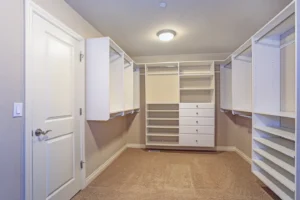
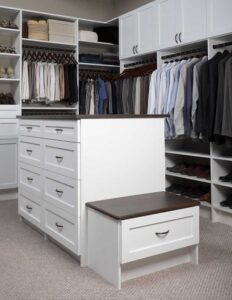
Why Heavy Wardrobes Accelerate Failure in Wall-Anchored Systems
Here’s the math most people don’t think about when they’re choosing a closet system.
A full wardrobe — winter coats, suits, dresses, shoes, accessories — can easily reach 300 to 400 pounds of distributed load. Some wardrobes exceed that. That weight doesn’t sit still. It shifts every time you pull a coat off a hanger, add a new item, or reorganize a shelf.
In a wall-hung system, that load is distributed across a finite number of anchor points — typically the mounting brackets for the main rail or the cabinet wall cleats. Each of those points is working against gravity constantly, and the stress compounds over time.
Standard drywall anchors are typically rated for 50 to 100 pounds each under ideal conditions. In older Dallas homes, those conditions rarely exist. The result is a slow failure — a bracket that starts to pull, a shelf that develops a visible sag, a rail that begins to separate from the wall — that accelerates as the wardrobe fills up.
The heavier your wardrobe, the faster a wall-hung system in an older home will fail. That’s not a quality issue with any particular brand. It’s a structural mismatch.
If you’re not sure whether your home’s construction is compatible with a wall-hung system — or if you’ve already seen early signs of failure — we offer free in-home consultations. I’ll look at your actual walls, your actual wardrobe, and tell you exactly what the right structural approach is for your specific space.
What “Permanent” Actually Means When a Closet Is Anchored to the Floor
I use the word “permanent” deliberately, and I mean it structurally.
A floor-based millwork system, properly installed, doesn’t move. It doesn’t shift, sag, or pull away from the wall as the years pass and the wardrobe fills up. It becomes part of the architecture of the room — the same way a built-in bookcase or a kitchen cabinet bank is part of the architecture of the rooms they’re in.
That’s the outcome standard I hold every installation to: it should look like it was always part of the house.
That’s not achievable with a wall-hung system in most older Dallas homes. Not because the materials are inferior. Because the structural foundation isn’t there to support it long-term.
Our photorealistic 3D design process shows you exactly what the finished system will look like before we build it. But the rendering is only half the story. The other half is the structural engineering underneath — the floor-based foundation that makes the finished product permanent, not provisional.
“The finished product was better than we had hoped for.” — M.S., Dallas Custom Closets customer
The Long-Term Cost of Choosing the Wrong Structural System
The price comparison between a wall-hung modular system and floor-based millwork almost always favors the modular option upfront. That math changes when you account for what happens next.
A wall-hung system that begins failing in year three or four in an older Dallas home isn’t just an inconvenience. It’s a reinstallation cost. It’s drywall repair. It’s the time and disruption of going through the selection and installation process again. And it’s the cost of doing it right the second time — which is what you should have done the first time.
I hear this from clients regularly: “I’m not doing this twice.” That’s exactly right. And the way you don’t do it twice is by choosing the structural system that’s built for your home’s actual construction — not the one that looks right in a showroom.
The long-term cost of floor-based millwork is lower than the long-term cost of a wall-hung system in an older home. Not because the upfront price is lower — it isn’t. Because you only pay it once.
Our White Glove installation process includes a full structural assessment of your space before we build anything. We’re not going to install a system that’s wrong for your walls. That’s not how we work.
What to Do Next
If you’re in Highland Park, Lake Highlands, or any of the older Dallas neighborhoods where pre-1980s construction is the norm, the structural question isn’t academic. It’s the first question you should be asking any closet company before you sign anything.
Ask them how their system transfers load. Ask them what happens when an anchor point fails. Ask them whether their installation is designed for your home’s actual wall construction — or for an idealized new-build that doesn’t exist in your neighborhood.
The answers will tell you everything you need to know.
Ready to See What a Permanent Solution Looks Like in Your Space?
We’ll come to your home, assess your actual walls and wardrobe, and show you a photorealistic 3D rendering of exactly what your new closet will look like — before we build a single piece.
No commitment. No pressure. Just a clear picture of what’s possible, and an honest conversation about what your home’s construction actually supports.
Request your free in-home design consultation → Book Now
Dallas Custom Closets · Veteran-Owned · Farmers Branch, TX · (469) 848-2881
FAQ
How does floor-based millwork prevent the sagging issues common with wall-hung modular closet systems in older homes?
Floor-based millwork transfers the weight of the entire closet system — including the full wardrobe — directly to the subfloor, bypassing the wall as a load-bearing element entirely. Wall-hung systems anchor into drywall or plaster, which in pre-1980s Dallas homes is often too thin, irregularly framed, or structurally inconsistent to support the cumulative weight of a loaded wardrobe over time. When the anchor points can’t hold the load, the system sags or fails. When the load goes to the floor, that failure point doesn’t exist.
What is the load-bearing capacity difference between a custom closet and a wall-hung modular system?
Standard drywall anchors are typically rated for 50–100 lbs each under ideal conditions. A fully loaded wardrobe can reach 300–400 lbs or more. Floor-based millwork distributes that load across the subfloor, which is engineered to support hundreds of pounds per square foot — the same structural member bearing the weight of your furniture, appliances, and foot traffic. The difference isn’t marginal; it’s a fundamentally different structural category.
Why do wall-hung closet systems fail faster in older Dallas homes than in newer construction?
Older Dallas homes — particularly pre-1980s construction in neighborhoods like Highland Park and Lake Highlands — frequently feature plaster-over-lath walls, irregular stud spacing (sometimes 24″ on-center rather than the standard 16″), and thinner drywall. These conditions make consistent, load-bearing anchor placement unreliable. Wall-hung systems installed in these homes are often anchored into drywall rather than studs, or into plaster that doesn’t hold anchors the way modern drywall does. The result is a system that begins failing as soon as the wardrobe reaches full weight.
 Why Closet Customization Is a Must for Better Organization