

Quick Summary
- Standard particleboard and MDF begin absorbing moisture and losing structural integrity when relative humidity exceeds 70% — a threshold Dallas garages routinely blow past in summer.
- Thermally fused laminate over a moisture-resistant substrate, powder-coated steel, and marine-grade materials are the three material categories that actually hold up in Texas heat.
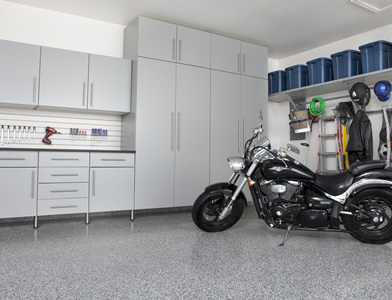
- A professionally designed, wall-mounted custom organization system eliminates the most common failure points: floor moisture, poor airflow, and inadequate anchoring under heavy loads.
Your garage shelves are warping. You noticed it last August — a subtle bow in the shelf holding your toolboxes, a drawer that suddenly doesn’t close right, maybe a cabinet door that’s started to peel at the corner. You told yourself you’d deal with it. Then the summer came back around.
This isn’t a fluke. It’s material science playing out exactly as expected in one of the harshest storage environments in the country.
Dallas garages regularly hit 130°F+ surface temperatures in July and August. Humidity swings from the dry 20s in winter to a muggy 80–90% in spring and after rain events. That daily thermal expansion and contraction — heat up, cool down, swell, shrink, repeat — is relentless. And the materials most garage shelving is made from? They were never built for it.
Why Standard Particleboard and MDF Fail in Dallas Garages
Here’s the honest truth about most big-box garage shelving: it’s designed for conditioned interior spaces. The moment you move it into an unconditioned garage, you’ve started a clock.
Standard MDF (medium-density fiberboard) and particleboard are engineered wood products made by binding wood fibers or chips together with urea-formaldehyde resin under heat and pressure. That sounds durable. In practice, the binding resin begins to break down when relative humidity consistently exceeds 70%, and that resin is what’s holding the whole panel together.
Think of it like a sugar cube left on a humid countertop. It holds its shape until it doesn’t. Once moisture penetrates the core, the swelling is permanent. Shelves sag. Doors delaminate. Drawer boxes, a rack, and jam. And if that shelf is holding 80 lbs of power tools when it fails, you have a safety problem, not just an aesthetic one.
This is why the material conversation matters so much — and why it goes beyond “just get something sturdier.”
The Materials That Actually Hold Up
When we design climate-resilient garage cabinets for Dallas homeowners, we’re evaluating materials against three specific stressors: sustained heat, moisture absorption, and the mechanical stress of heavy loads over time. Here’s what passes that test.
Thermally Fused Laminate (TFL) on a Moisture-Resistant Substrate
TFL is the material category that separates premium custom cabinetry from the stuff at the hardware store. A decorative paper layer is fused to the substrate under extreme heat and pressure, creating a surface that is chemically bonded — not glued on. There’s no edge to peel, no seam to lift, and no surface for moisture to penetrate.
Paired with a moisture-resistant MDF or industrial-grade particleboard core (which uses a phenolic resin binder instead of urea-formaldehyde), TFL cabinetry can handle the temperature and humidity swings of a Texas garage without warping, delaminating, or losing its finish.
The result is a cabinet that looks as sharp in year five as it did on installation day.
Powder-Coated Steel
For open shelving, workbenches, and structural components, cold-rolled steel with an electrostatic powder-coat finish is the gold standard. The powder coating isn’t just paint — it’s a polymer shell baked onto the metal surface at 400°F, creating a barrier that resists chipping, rust, and oxidation even through humid Texas summers.
Compare this to standard galvanized shelving, which can begin showing rust at stress points (cut edges, drill holes, mounting hardware) within a single season of humidity exposure. Powder-coated steel simply doesn’t have that vulnerability.
Marine-Grade Plywood and Specialty Veneers
For applications requiring real wood aesthetics — think custom workbench surfaces or accent panels — marine-grade plywood is the correct specification. It’s manufactured with waterproof phenolic glue between every ply, eliminating the internal voids that cause standard plywood to delaminate in moisture-rich environments. It’s the same material standard used in boat construction, which tells you everything you need to know about its humidity credentials.
The Design Details That Make the Difference
Choosing the right material is step one. But even the best materials can underperform if the system isn’t designed correctly for the environment. Here’s what separates a well-engineered garage organization system from a collection of expensive cabinets.
Get Everything Off the Floor
The floor of an unconditioned garage is the most moisture-prone surface in the space. Concrete is porous. It absorbs ground moisture and releases it as vapor — especially after rain or during seasonal humidity shifts. Any cabinet sitting directly on that slab is wicking moisture from below, regardless of what it’s made of.
Wall-mounted systems eliminate this entirely. With cabinets suspended off the floor, you also gain the practical bonus of being able to sweep and clean underneath — and your epoxy floor coating stays protected during installation and for years afterward.
Airflow Is Not Optional
Cabinetry installed tightly against a wall with no airflow gap creates a microclimate behind the panels. In a humid environment, that trapped air leads to condensation, and condensation leads to mold — both on the cabinet back and on the wall itself.
A thoughtfully designed system incorporates breathable slatwall configurations for tools and gear, strategic spacing behind enclosed cabinets, and ventilation-aware placement. This is something our designers model during the 3D design phase, so airflow is planned before a single bracket goes into the wall.
Hardware Built for the Environment
Soft-close drawer slides and hinges are precision components. In a garage that swings from 40°F in January to 130°F in August, low-quality hardware will bind, corrode, or lose its tension. We specify hardware rated for these temperature ranges — which is why our clients tell us their drawers still glide years after installation perfectly, not just on day one.
What a Properly Installed System Looks Like
When our team completes a professional garage organization installation, the process is methodical and thorough. We start with a complimentary, in-home consultation — measuring the space, understanding how you actually use it, and building a 3D rendered model of the proposed system before anything gets ordered.
Installation day is a white-glove process. We protect your floors throughout, anchor every component securely into wall studs, and leave the space clean and ready to use. The system is backed by a lifetime guarantee — because when materials and installation are done right, that’s a promise we’re confident making.
If you’ve been frustrated by sagging shelves or failing cabinets, you’re not dealing with a maintenance problem. You’re dealing with a materials and design problem. And that has a permanent solution.
Conclusion & Next Steps
Dallas summers don’t give garage storage systems a pass. The heat, the humidity swings, the sheer weight of everything we ask our garages to hold — it’s a demanding environment that exposes the limits of standard materials quickly.
The good news is that the right materials, combined with thoughtful design and professional installation, produce a system that genuinely lasts. If you’re ready to stop replacing shelves and start enjoying a garage that works as hard as you do, we’d love to show you what’s possible.
Request your free design consultation — we’ll bring the 3D model to you.
And if you’re thinking beyond the garage, our custom mudroom storage systems apply the same philosophy to the hardest-working entry point in your home.
 Why Closet Customization Is a Must for Better Organization